



Some pain slips away… but other pain? It sits in your chest like a fizzy gulp of an energy drink that refuses to turn into a burp.
You hit replay and imagine the conversation you wish had happened. In your mind, it’s like watching a third-person scene where they finally look at you and say, “I’m sorry… I shouldn’t have done that.”
But then reality taps you on the shoulder with a painfully simple truth:
They aren’t going to say it.
Nope.
And worse? They don’t care.
Stings doesn’t it? I hate to be the bearer of bad news but that is the sad reality of it.
Lets be honest with ourselves: humans are….unfortunately….very selfish.
That’s why forgiveness feels impossible for us — because forgiveness without an apology?
Pssshhhh. Get outta here.
You wish you could do that, don’t you? Me too.
I hate to break it to you, we can’t. Why? Because Christians are unique. Set apart from the world. We follow a moral code.
Don’t fret, you’re absolutely normal for feeling contrary to (that’s why Jesus says the way is hard) this. But, this isn’t what God wants for you.
And, this is exactly where God steps in with a freedom that doesn’t depend on their humility… only yours.
(Paid subscribers - For bonus content and audio/video overview scroll to bottom)
Related Articles


Why Forgiveness Doesn’t Need Their Apology to Set You Free
Here’s the truth we don’t want to admit: you don’t really want revenge. What you really want is a grand gesture. The red carpet rolled out with them on their hands and knees begging for your forgiveness. And, you want it to be GENUINE.
Ohh yea, I just went there. Don’t worry, this is human. You’re not abnormal for thinking this way. You just need a little guidance.
The strange part we don’t like: that apology never comes. Or, it comes so late that you don’t even want to hear it anymore.
Your brain starts trying to solve an emotional math problem with missing numbers. You wonder:
“Was I overreacting?”
“Should I have been stronger?”
“Did I make this bigger than it was?”
You didn’t.
Your heart was asking for something normal — acknowledgment.
But their silence doesn’t mean your pain isn’t real. It just means their heart wasn’t ready to face it.
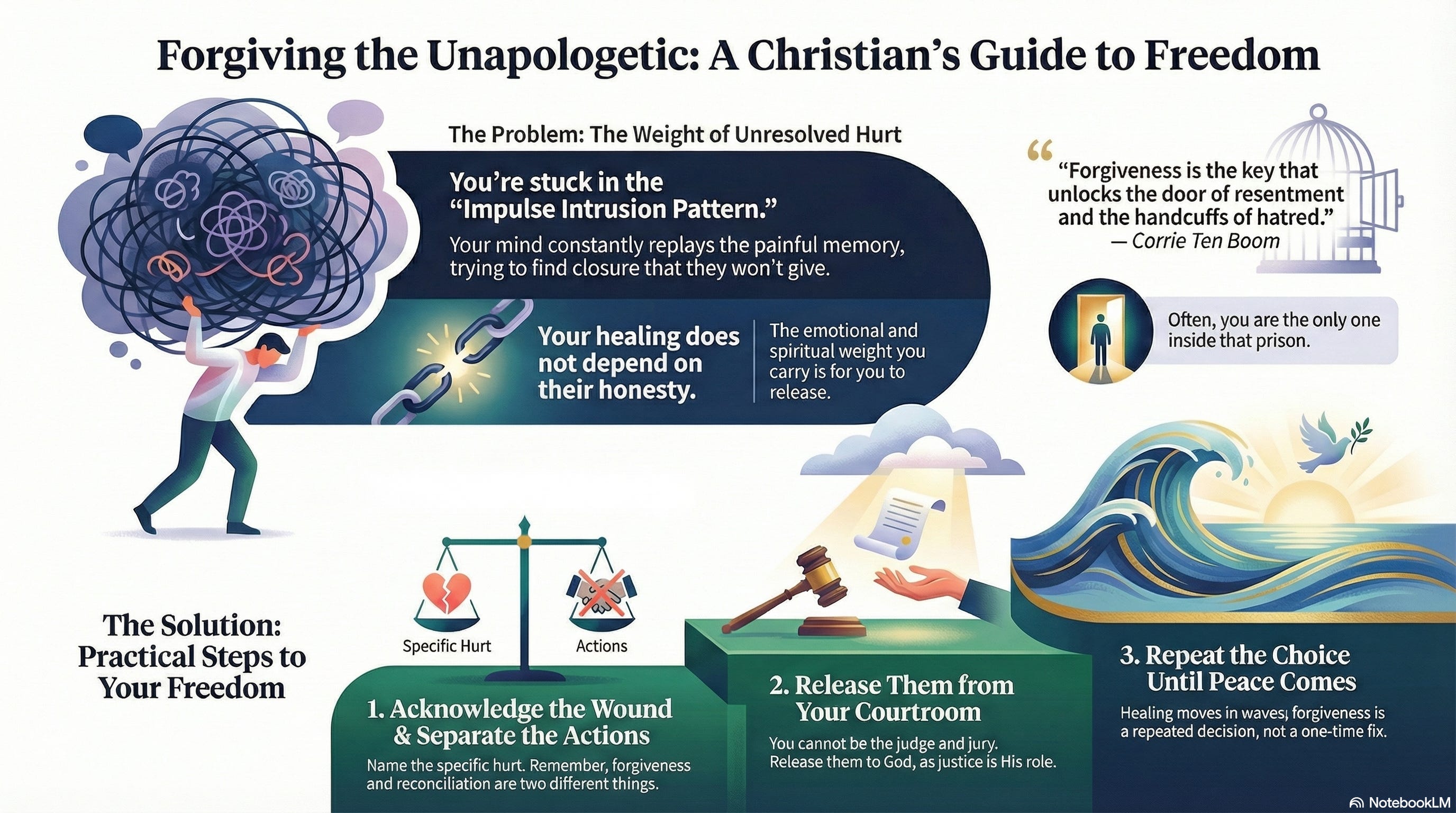
Corrie Ten Boom said, “Forgiveness is the key that unlocks the door of resentment and the handcuffs of hatred.”
And here’s the twist:
Sometimes the door and the handcuffs are both inside your heart — not theirs.
Forgiveness frees you, not them.
When the Apology Never Comes

Every Christian eventually faces a hard truth:
You cannot make someone take responsibility.
You can pray for them until you’re blue in the face but you cannot force humility into a heart that’s not ready.
Their silence creates a loop — that mental “replay” you never asked for. One moment you’re washing dishes, and bam, the memory drops in like it owns the place. This is what I call the Impulse Intrusion Pattern — your mind trying to find closure in a story someone else refused to finish.
The enemy loves this moment. He whispers:
“You see? You didn’t matter.”
“You’re still stuck.”
“Look how they moved on without you.”
Forgiveness interrupts that whisper.
The Hidden Weight Beneath Unspoken Pain
Not getting the apology changes something in you — It doesn’t mean you’re fragile, but God designed you for truth. When someone refuses to face what they’ve done, it can make you feel invisible.
But listen closely:
Your healing does not depend on their honesty.
Forgiveness is not approval or pretending like what they did was okay.
Forgiveness is opening the door of the prison room… and realizing you’re the only one inside.
Practical Steps to Forgive Someone Who Isn’t Sorry
You’ve heard sermons about forgiveness.
You’ve heard “pray about it.”
But let’s talk about what this looks like in real life, with real emotions, on ordinary Tuesdays when your heart is tired because honestly? I really hate the generic answers we always get. It never gets to the root of the problem. Only bandages the symptoms.
Soooo here are steps that actually help:
1. Name the wound honestly
Get specific.
General pain cannot heal — only named wounds can.
“God, this hurt because…”
Write it.
Say it.
Acknowledge it.
While you’re at it, fill out our forgiveness wall form.
You remain anonymous and at the end of the week my wife and I will do a live video prayer for you!
2. Separate forgiveness from reconciliation
Reconciliation requires two humble hearts.
Forgiveness only requires yours.
You can forgive someone and still create distance.
You can forgive someone and still block their number.
You can forgive someone and never be close again.
Boundaries aren’t unchristian — they are stewardship.
3. Expect the emotions to return
This doesn’t mean your forgiveness wasn’t real.
Healing moves in waves.
When the memory returns, recognize it as the Impulse Intrusion Pattern — your mind trying to rehearse a moment that God has already invited you to release.
That realization alone is powerful.
4. Release them from your courtroom
You can’t be judge, witness, jury, and executioner.
That role belongs to God.
This is where forgiveness shifts from emotional to spiritual:
“Lord, I release them from what they owe me.
I trust You with this case.”
Justice is God’s responsibility, not yours.
5. Pray for their heart — not because they deserve it, but because you deserve peace
You’re not praying to make them feel better.
You’re praying so bitterness doesn’t rot the inside of your heart.
It’s a quiet prayer, often awkward at first:
“Lord, soften what has hardened in them.”
Not for them… for your freedom.
6. Forgive again tomorrow if needed
Forgiveness is sometimes a one-time declaration.
Often it’s a repeated decision until the grip of the pain loosens.
If you wake up and think, “Ugh… I still feel it,” that doesn’t mean you failed.
It means healing is still happening.
And that’s normal.
7. Remind yourself what forgiveness actually is
It’s not pretending.
It’s not forgetting.
It’s not excusing.
Forgiveness is simply refusing to keep drinking poison because they won’t admit what they did.
And here’s the truth:
You are worth too much to carry this wound any longer.
When Forgiveness Needs More Than a Decision
Most Christians think forgiveness is a single moment where you whisper, “I forgive them,” and suddenly the skies open, your heart lightens, and birds start singing like it’s a Disney movie.
But real forgiveness — forgiveness when someone isn’t sorry — is more like physical therapy.
It works… but it stretches places you didn’t know were tight.
This is where deeper healing begins.
Because yes, forgiveness starts with a choice.
But it continues with a process.
And that process isn’t always pretty.
There will be days when you feel peace…
Then something taps the bruise again and you think, “Why am I still hurting?”
There will be days when you forgive…
Then wake up the next morning replaying the moment like it just happened.
This doesn’t mean your forgiveness “didn’t work.”
It means your heart is finally starting to thaw.
God doesn’t rush healing because He’s not interested in surface-level change.
He heals you deeply — the kind of deeply that allows you to walk into the future without dragging the past behind you like a broken suitcase.
The Spiritual Battle Most People Overlook

Forgiving someone who isn’t sorry is not just emotional — it’s spiritual.
When the apology never comes, three doors often crack open in the heart:
Bitterness — the silent kind that grows slowly
Self-blame — the voice that whispers, “Maybe you deserved this”
Distrust — the shield that blocks people who actually love you
The enemy loves all three.
Because if he can’t get you through the wound, he’ll try to get you through the aftermath.
This is where Scripture becomes more than words on a page — it becomes your strategy.
Your weapon.
Your grounding point.
Forgiveness isn’t a denial of wrongdoing.
It’s a declaration of spiritual clarity:
“I refuse to let darkness use this moment to define me.”
That’s why Revelation 12:11 matters here — your testimony of forgiveness becomes a weapon against the enemy’s accusations.
How to Break the Replay Loop (The Impulse Intrusion Pattern)
🔒FOR PAID SUBSCRIBERS ONLY
When your mind keeps rehearsing the moment, saying “Stop thinking about this” does nothing. The brain doesn’t work that way.
Instead, replace the pattern.
Here’s the simple method:
Step 1 — Recognize the replay
The moment you notice the memory popping up, identify it out loud (or in your mind):
“This is the replay talking, not reality.”
Step 2 — Redirect with truth
Pick one verse and speak it every time the replay starts.
Here are strong options:
“The Lord is near to the brokenhearted.”
“Cast your cares on Him.”
“He restores my soul.”
Step 3 — Reclaim your attention
Shift your focus to something present:
your breathing, a sound in the room, the temperature on your skin.
The spiritual world and the brain have one thing in common:
they both respond to attention.
Where your attention goes, your healing follows.
Do this consistently, and the replay begins losing power.
When Forgiveness Finally Starts to Feel Real
Most people expect forgiveness to feel like a warm wave of peace.
But often, it feels like something much quieter:
A memory that doesn’t sting as sharply
A morning where they’re not the first thing you think about
A conversation about them where your voice doesn’t tighten
A small sense of distance between you and the hurt
A softening in your chest you didn’t expect
Forgiveness becomes real the moment you realize the wound isn’t steering your life anymore.
You still remember — but you no longer relive.
You still acknowledge the pain — but it no longer directs your choices.
And slowly, God turns the scar into something you can actually talk about without breaking… something that others can be helped by.
That’s the miracle of forgiveness.
It doesn’t rewrite the past.
It releases your future.
Reflection & Prayer
Reflection:
Which part of your heart still feels connected to the person who hurt you — the memory, the silence, or the expectation?
Prayer:
“Lord, I give You the parts of my heart that are still healing. I give You the moments that replay when I’m tired or overwhelmed. I give You the disappointment, the silence, the questions, and the weight. Teach me to forgive with Your strength, not mine. Break every replay loop that keeps me stuck, and lead me into the freedom You promise. Amen.”
BONUS SECTION
A blended set of tools to help you walk this out:
1. Audio Overview
2. Video Overview
3. Report
A short guide: “The Psychology + Scripture of Forgiving the Unrepentant.”
4. What forgiveness does in the heart over time.
I had an NDE 5 yrs ago. It has changed my perspective completely. Was a drug reaction between prescription drugs. When I regained consciousness, lay there with my wife holding my upper body out the muck in the corral I had an image stuck in my mind. I mumbled to my wife I’ve had the strangest dream. They got me to the truck and left me there to recuperate while they pulled the calf and saved the cow. (Yes I guess I was somewhat abandoned as well! But they did save the calf🤔😂)My skin colour slowly returning from a greenish/ grey colour. They cleaned me up got me on the bed and checked my BP, it was still low forties. That image stayed in my mind, someone with shoulder length dark hair before me he had a sword on his hip. I wasn’t afraid of death, I felt at peace and even euphoric about moving on. Thought of my wife, family and then thought they will be fine Gods will prevailing. I can’t explain the emotions brought out from that image/ experience and I don’t truly know the meaning. I do know that I still do not truly fear death. I know there is an afterlife. I believe in and follow Jesus much more devoutly than before. Perhaps it was a warning. A second chance to live better and to bring others to Christ? I don’t know. But it has had a profound effect on my life. 🙏🙏🙏
Absolutely...carrying a hurt is unhealthy. Move on.
Pray that God will remove all bitterness. It works!