

Have you seen him too?
The Bible Called Him a "Ruler of Darkness" Long Before the Internet Called Him "Hat Man"

Ever woken up in the middle of the night and he’s just standing there?
Maybe it’s the foot of the bed or the doorway. Wide-brimmed hat, long dark coat, no face you can make out. Your chest feels like someone parked a truck on it. You try to scream and nothing comes out. Then, just as suddenly, you can move again, and he’s gone, and you lie there with your heart slamming against your ribs wondering what in the world just happened to you.
You’re not the only who has experienced this. People across five continents, different languages, different religions, different bedrooms, describe the exact same hat. Researchers call it “sleep paralysis.” The internet calls him “Hat Man.” And for years now, that’s where the conversation has stopped, right at the edge of an explanation that covers the paralysis but never touches the claw marks.
We’re closing that gap today.
Other Articles


The Uniform
Every account of this thing describes the same outfit. Hat. Coat. Sometimes a tie. Always dressed like he’s got somewhere important to be. Not a coincidence, and it’s not a fashion choice made up by scared teenagers comparing notes online. Ancient peoples had a word for beings that dress like their authority — they called them rulers, powers, principalities. The uniform is simply rank.
“For we do not wrestle against flesh and blood, but against principalities, against powers, against the rulers of the darkness of this age, against spiritual hosts of wickedness in the heavenly places.” — Ephesians 6:12
Paul wrote that line to a church in Ephesus that already knew exactly what he meant, because their whole city was steeped in exactly this kind of thing — spirits with jurisdiction, hierarchies you couldn’t see but absolutely had to deal with.
The Chain of Command
A lot of people stop reading Ephesians 6:12 too early. Paul doesn’t just say “evil spirits” and leave it vague. He lists rank in descending order — rulers, then authorities, powers, spiritual hosts of wickedness. That’s a military structure.
Daniel 10 shows you this chain of command in action, not theory. Daniel prays and fasts for three weeks and gets nothing — a being with a title, “the prince of the kingdom of Persia,” stood in the way of the answer until a higher-ranked angel broke through. That’s a territorial spirit with actual jurisdiction, blocking a prayer for three straight weeks. If you’ve ever felt like your prayers were hitting a ceiling instead of heaven, you’ve felt that same resistance.
This matters for the man in the hat because it means he’s not a lone wolf. Witnesses describe him watching and waiting — never quite acting alone, always operating like he’s reporting to someone. The Uniform he wears is the visible edge of a hierarchy most people never think to ask about.
Why He Comes Through the Paralysis
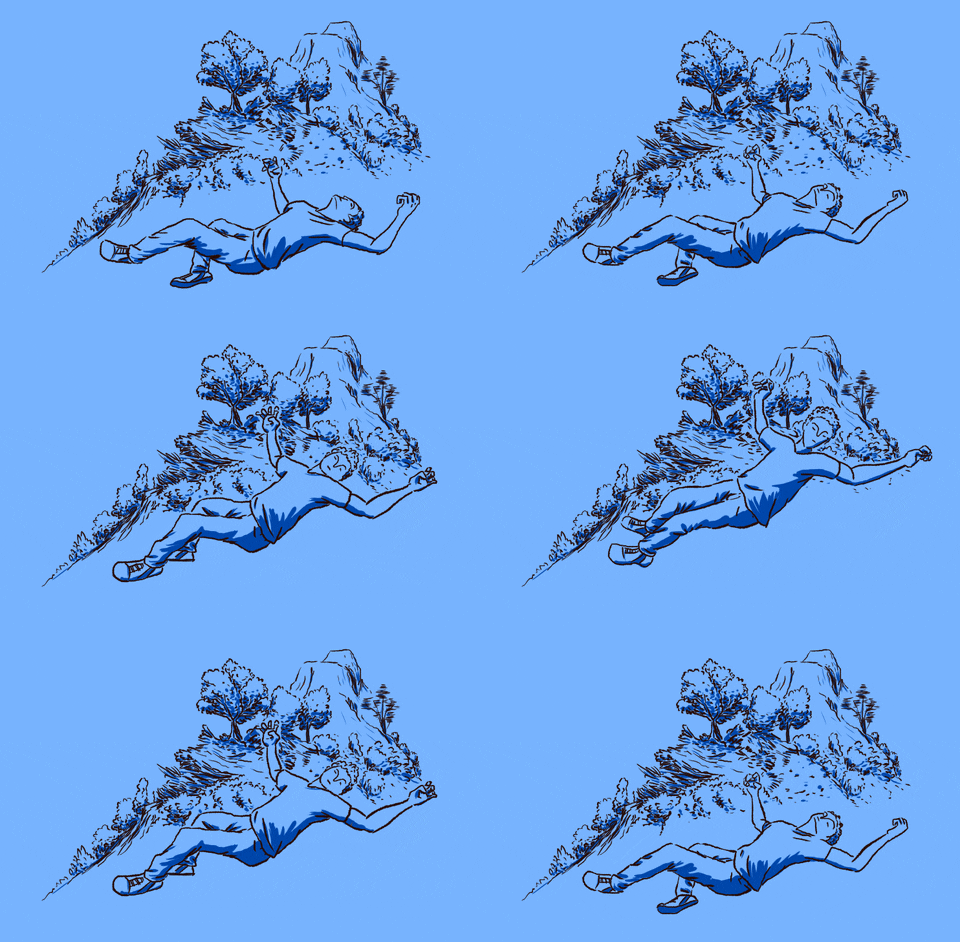
Atonia is real. During REM sleep, your brainstem sends a signal that shuts off your voluntary muscles so you don’t act out your dreams — kick your spouse, sleepwalk off a balcony, swing at something that isn’t there. It’s a safety mechanism. Most nights it works perfectly and you never even know it happened. But sometimes your mind wakes up before your body gets the memo, and for anywhere from a few seconds to a few agonizing minutes, you’re fully conscious and completely locked. Eyes open, sometimes. Aware of the room, but unable to lift a finger.
That window has a name in sleep medicine — isolated sleep paralysis — and it has known triggers. Fragmented sleep. Sleeping on your back. Sleep debt. Irregular schedules, the kind a lot of us carry from shift work, late nights, or a phone screen at 1 a.m. And yes — antihistamines like Benadryl show up again and again in these accounts, because they interfere with the same sleep architecture that governs atonia. None of that is controversial. Ask any sleep doctor and they’ll walk you through the mechanism without blinking.
Here’s the question sleep medicine doesn’t ask, because it’s not medicine’s job to ask it: why this window, specifically, across cultures and centuries, keeps producing the same visitor?
Spiritual opposition is calculated, waiting for the moment a person is weakest. Job’s friend Eliphaz describes exactly this state in Job 4:13-15 — “in thoughts from the visions of the night, when deep sleep falls on men, fear came upon me, and trembling,” a spirit passing before his face while his body lay frozen, centuries before anyone had a clinical term for it.
A body locked in place with a fully alert mind is about as defenseless as a human being gets — no ability to run, fight, or even call out. If you were looking for a moment to press an advantage, you couldn’t design a better one. Sleep science built the door. It never claimed to know who walks through it.
Fighting Back: What to Do in the Moment
This is the part almost nobody teaches, because most content either stays purely clinical (”just breathe and wait it out”) or purely spooky (”here’s seventeen more terrifying stories”). Neither one gives you a plan.
Speak — even if it’s only in your mind. Witnesses across hundreds of accounts report that the moment they manage to say a name, even silently, the paralysis breaks or the presence leaves. James 4:7 isn’t poetry — submit to God, resist the devil, and he will flee from you. The name of Jesus, called on even without a working voice, is not a magic word. It’s an act of submission and authority at the same time.
Stop fighting your body and start praying your mind. Thrashing against paralyzed muscles only feeds the panic loop and can extend the episode. Redirect that energy into a single fixed prayer — the Lord’s Prayer, Psalm 23, anything memorized cold enough that terror can’t erase it.
Break the cycle physically once you can move. The second control returns, sit up, put your feet on the floor, turn on a light. Don’t lie back down immediately — these episodes can recur in the same sleep cycle if you drift straight back under in the same position.
The moment of paralysis is the worst possible time to start fighting this battle. The real fight happens earlier, in the hours before your head hits the pillow.
Pray over the room, not just yourself. Ask God to set a guard over the doorway, the corners, the hours you’ll be unconscious and unable to defend yourself.
Fix what’s feeding the fragmentation. Sleep debt and irregular hours don’t just make you tired, they widen the very window these episodes live in. Protecting your sleep schedule is spiritual warfare with an alarm clock. Cut the late-night screen time, watch the antihistamines, get consistent hours. You’re closing a door, not just improving your health.
Keep scripture physically near you. Not as a charm, but as a declaration — a Bible on the nightstand, a verse taped to the doorframe. Daniel prayed toward Jerusalem with his windows open on purpose, visibly, consistently, three times a day. Physical, visible devotion was never beneath him, and it isn’t beneath you either.
Don’t do this alone. Tell someone — your spouse, your prayer group, your pastor. Isolation is the exact condition this kind of activity prefers, and secrecy has never once made a person safer.
Where This Leaves You
The window is real. Your brainstem really does lock your body down every single night, and most nights nothing comes through it. But on the nights something does, you have a name to call on before you’re ever paralyzed, and you have a plan for the seconds when you are. Job’s friend trembled and said nothing back. You don’t have to make the same choice he did.
As Charles Spurgeon put it, believers are never left to face the powers of darkness in their own strength, but are called to stand fully armed in Christ’s.
John Chrysostom, preaching on this same passage centuries ago, reminded his congregation that the fight described in Ephesians is against unseen princes, not visible men — which means it was never going to be won by pretending the enemy doesn’t have a name, and it was never going to be won by fear either.
Sources & References
Scripture
Ephesians 6:12, 6:10-18 (NKJV) — the armor of God passage
Daniel 10:1-14 — Daniel’s three-week delay and the “prince of the kingdom of Persia”
Job 4:12-15 — Eliphaz’s account of a spirit passing before his face during night terror
James 4:7 — “Resist the devil and he will flee from you”
Colossians 1:16, 2:15 — Christ’s authority over principalities and powers
1 Peter 5:8 — “Your adversary the devil walks about like a roaring lion”
Historical/Patristic Sources
John Chrysostom, Homilies on Ephesians, Homily 4, available via New Advent’s Church Fathers collection (newadvent.org/fathers/230104.htm) — addresses Ephesians 6:12 directly, describing Satan’s dominion as operating “under Heaven” through ranked spiritual powers.
Charles Spurgeon, Sermon No. 2201, “The Sword of the Spirit,” preached at the Metropolitan Tabernacle — repeated use of the phrase “the powers of darkness” in direct connection to the armor of God passage. Full text available via the Charles Spurgeon Sermon Archive.
Note on quotations: the Spurgeon and Chrysostom lines used in this article are close paraphrases of their broader teaching on this passage rather than word-for-word quotations.
Sleep Science
American Academy of Sleep Medicine — clinical overview of isolated sleep paralysis, REM atonia mechanism, and known risk factors (irregular sleep schedule, sleep deprivation, supine sleep position)
Baland Jalal’s published research (UC Berkeley/Cambridge) on the neuroscience of sleep-paralysis “sensed presence” hallucinations.