

Nobody Calls a Toddler a Failure for Falling. So Why Do You?
The double standard we apply to ourselves — and why it's turning every sin into a life sentence.


"Though he fall, he shall not be utterly cast down, for the LORD upholds him with His hand." — Psalm 37:24
Why is it, that whenever adults trip and fall, there is always this immediate internal failure? Think about it. Have you ever tripped and fell down before? I think most of us have at least once in our life — if not a dozen times.
Picture it. You’re in public place. Maybe doing some grocery shopping. You step on a slick spot. You trip. Everyone sees it. And now? You’re embarrassed, and there’s this internal shame spiral that’s absolutely wrecking you.
Humiliating, isn’t it? I know I’ve been there. More than once. And if you’re anything like me, sometimes you can be your own worst enemy. Or critic.
As adults, we tend to apply this standard to ourselves when it comes to sin. This is especially true for the born-again Christian, whose walk with Christ can sometimes become the very thing that trips them.
Alright. Let’s dive into it. Handing this over to Bethany Heyne.
Other Articles

Shame Is Installed, Not Innate
Erik Erikson, is more than just a cool name. He’s the psychoanalyst who explained how social relationships affect our sense of self.
His eight stages of development answer central psychosocial conflicts, like trust versus mistrust and autonomy versus shame, with each stage building either a solid or insecure foundation for subsequent stages of life.
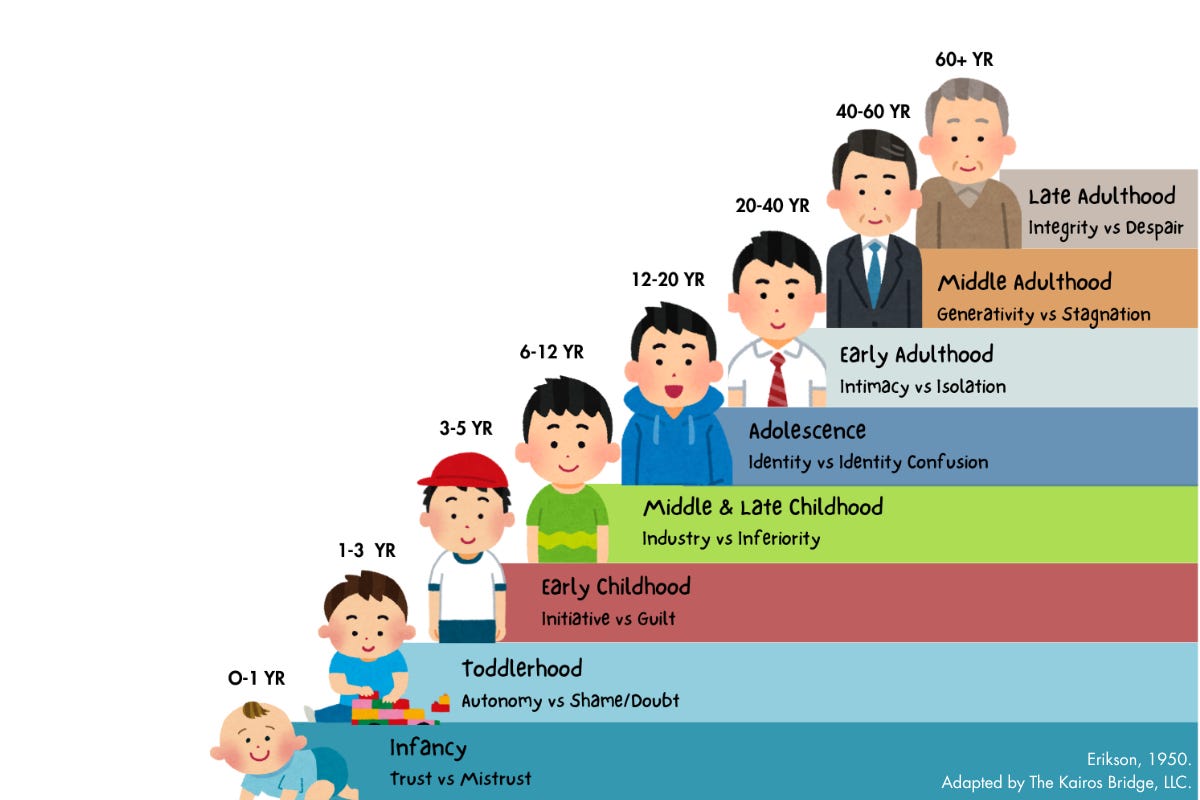
When a toddler takes a courageous first step and we cheer them on, even grabbing our cameras, knowing full well they won’t make it very far the first time. When they fall, we offer healthy and responsive encouragement that encodes autonomy into the child’s sense of self: “I can do this.”
A toddler doesn’t feel shame for falling because their brain has not been trained to link an outcome (falling/failure) to their identity (shame), unless of course the adults around them respond to those early stumbles, potty accidents, spilled cups, and other failures with ridicule, impatience, or “why can’t you just …”. That’s when toxic shame first gets encoded as the default response to failure.
The capacity for shame is installed, not innate.
Ideally, the home remains an encouraging and non-evaluative environment for young children to explore, learn and play. When they try new things on their own like feeding themselves, tying their own shoes, or making mudpies in your good cookware, they are practicing initiative.
If, however, the adult in the room responds with a heavy sigh, a groan, or swooping in to do it for them because “they’re taking too long, I can do it faster,” that shame is not only reinforced, but now guilt enters for being in the way, causing trouble, or being “too much to handle.”
This effect compounds when kids move into evaluative environments with classrooms or sibling. Healthy environments for learning encourage children to step outside their confort zone and learn newthings like friendship, math, reading, and asking for help. Erikson terms this “industry” though I like to refer to it as capability.
But when classrooms and home environments:
critique a child’s approach to a project, autonomy starts to slip
give highly critical evaluations of performance rather than progress, confidence in capability begins to slide
don’t communicate to the child that they matter and are cared about, their sense of relatedness and belonging tank
Which all boils down to feeling inferior to their peers. (credit to Ryan & Deci as they describe self-determination theory).
By the time a child is 11, they’ve explored autonomy, initiative, and capability/competence and have either been encouraged to see setbacks as opportunities for comebacks, or have been measured and found lacking, which leads to doubt, shame, guilt, and inferiority.
The late-teen years are often termed the launch-years given the focus on preparing kids for the adult world of bills, laundry, jobs, insurance, personal accountability…the list goes on.
If raised in an authoritative parenting home, you were given opportunities to practice these skills before you flew the nest. Maybe you got a job, did your own laundry, or started to pay for your own insurance.
For those who never had the supportive environment to build these skills, the adult world can feel like we’re navigating the swinging punching bag section of the latest Ninja Warrior obstacle course. We can barely get our footing steady before another bag swings our way, knocking us off our feet.
By adulthood, the inner voice has changed from “did I learn something new” to “did I do this well?” and often times, the answer comes not just from an inner voice but from performance reviews, social comparison, metrics, and deadlines.
Whose Voice Are We Listening To?
Our God transcends time. He was there in our past, here in our present, and already in our future. That moment that inner voice took a negative turn in childhood or adulthood, God was and is there, which means He can redeem it. Still. Today.
The field of neuroscience is fascinating, not only in it’s learnings, but in the fact that is it proving the very things Scripture has long held about renewing and restoring our minds. God can do it and does it everyday.
That’s the surrender we must start with for renewal. But here’s where the rubber meets the road; the parts of ourselves left behind in childhood need to mature forward into adulthood.
That toddler who wasn’t given space to does something for themselves, doesn’t have to stay the adult to lives in codependency
The preschooler whose crazy inventive ideas were dismissed for being so outlandish doesn’t need to hide them in the basement anymore
And the middle schooler who rarely stepped outside their comfort zone to try something new? That’s where we start
Because the ability to do things well simply comes from practice. But a child who was not given the space to try, fail, receive helpful feedback, and be encouraged to try again needs to have that nurtured today… at 27…39…45.
Wise mentors, counselors, coaches, trusted friends, coworkers or bosses can be our scaffolding as we set goals and try hard things. And we should be encouraged to do so because Philippians 1:6 encourages us that “He who began a good work in you will carry it on to completion until the day of Christ Jesus.” If we are alive and still breathing, God is still doing a good work in us.
We are being transformed into the likeness of Christ, day by day, until that glorious day of His return: Romans 8:29; 2 Corinthians 3:18; Romans 12:2; Colossians 3:10; Galatians 2:20; 1 Corinthians 15:49; 1 John 3:2; Ephesians 4:24; Romans 12:1-21.
Operating from this confidence in Christ, there is no condemnation in our failure. Every setback is simply a set up for a comeback. (adapted from YouTube’s @george4jc148)
Just like our kids wouldn’t expect to hit a three-pointer without practice, we to can use each missed shot as a data point.
The thing God has called us to that doesn’t seem to be coming to fruition? Every day is a new learning, not another failure.
The idea we pitched that got rejected can be seen as a failure, or a highly valuable feedback session to revise and pitch better to the new group.
That’s what our “failures” are. Not stamps of shame, but points of data, just like a toddler learning how to put one step in front of the other.
The Gift of Shame
Here’s where shame takes on new meaning in Christian life.
Behind every self-shame statement is a similar underlying message: I am deficient. The deficiency changes each time: I am bad. I am not good enough. I can’t do anything. But every blank we fill in is an admission of our limitation.
And that limitation is a hint at the underlying need of our human nature. Healthy shame tells us: I need help. I need encouragement. I need support. I need another chance. I need to try again.
Healthy shame is an admission of true humility, which invites us to turn toward Our Creator, the source of where we derive our worth and identity. We all make mistakes, we don’t have all the answers, and we all have need of a Savior because we cannot do it on our own.
It’s when our statements of deficiency turn us to strive toward an unhealthy measure, one we may never have been intended to meet, that shame becomes toxic and unhealthy.
Healthy shame is a condition of our human birth, not something we get over (credit Jeff Schulte and Phil Herndon). It helps us embrace the fact that we are not able to live fully on our own.
Therein lies the gift of healthy shame: surrender to the One Who Is Enough because apart from Him we can do nothing (John 15:5).
So How Do We Tackle This Voice of Shame?
True freedom isn’t found in silencing the voice, but rather identifying whose voice it actually is. Why? Because it needs to be externalized. We must realize “This voice is not my assessment of me. It’s a recording of someone else’s assessment that is playing on a loop.” When we externalize that, we give ourselves permission to turn away from that voice and look for the Voice of Truth, Who Tells A Different Story (gotta love that Casting Crowns song!)
· Notice It ·
Catch the negative shame talk sentence. Not just the feeling, but specifically the sentence being said. It takes practice, but once we recognize the sentence, we can externalize it and use appropriate verbal grounding to re-write the narrative
· Name It ·
Write the sentence down: “I’m so stupid” or “Why can’t you get this right”. When we write or verbalize it, it minimizes the threat bouncing around in our head. Then ask “whose voice is that, actually?” Self-criticism is almost always traceable back a teacher’s sarcasm, a parent’s impatience, a coach’s belittling, or culture’s comparison. The point isn’t for the sake of blame, but for the sake of breaking the fusion between that person’s voice and your own inner voice. It stops being “the truth about me” and gets boiled down to “a thing I was taught to say about myself”. Then, turn the phrase around and ask “what is it that I need to be able to succeed in this? Encouragement? Support? Help? Advise? Wisdom?”
· Nurture It ·
Replace the negativity with the response and support that was missing from childhood. Essentially, become the voice of the adult you needed to hear at a younger moment in life. This isn’t about “toxic positivity” self-talk, this is about being specific: “that didn’t work, let’s just try again.” It doesn’t replace the false narrative overnight, but repeated truth speaking rewires the brain to recognize the better path of autonomy, initiative, capability, and belonging. Time in God’s Word is the single greatest source of truth about who we are and whose we are. We are created in the image of the most creative, magnificent, awesome being. God’s relentless pursuit of us, through His Son Jesus Christ, is proof enough of our value and our worth. If He, the God of the Universe, is willing to put that much time and effort in for you and for me, then surely He doesn’t shame a toddler for falling down, nor does He speak shame over our daily setbacks.
 | A guest post by
|