

The Pull of Past Habits: A Christian Reflection on Jeremiah 44 and John 5:14
Why We Keep Going Back to What God Pulled Us Out Of - Mark’s Monthly Random Word Report

(paid subscribers - for audio voice-over scroll to bottom)
“Afterward Jesus found him in the temple and said to him, ‘See, you are well! Sin no more, that nothing worse may happen to you.’ — John 5:14
This Month’s Word: Return
Funny word, isn’t it?
Sounds harmless. Cozy even. Like returning home, returning a library book, returning to normal after the holidays.
But spiritually?
“Return” can get a little heavy.
Because sometimes we aren’t returning to good things — we’re drifting back to old chains we swore we buried.
And that’s exactly where Jeremiah 44 smacks us in the chest.
Jeremiah 44: The Strange Nostalgia for Sin
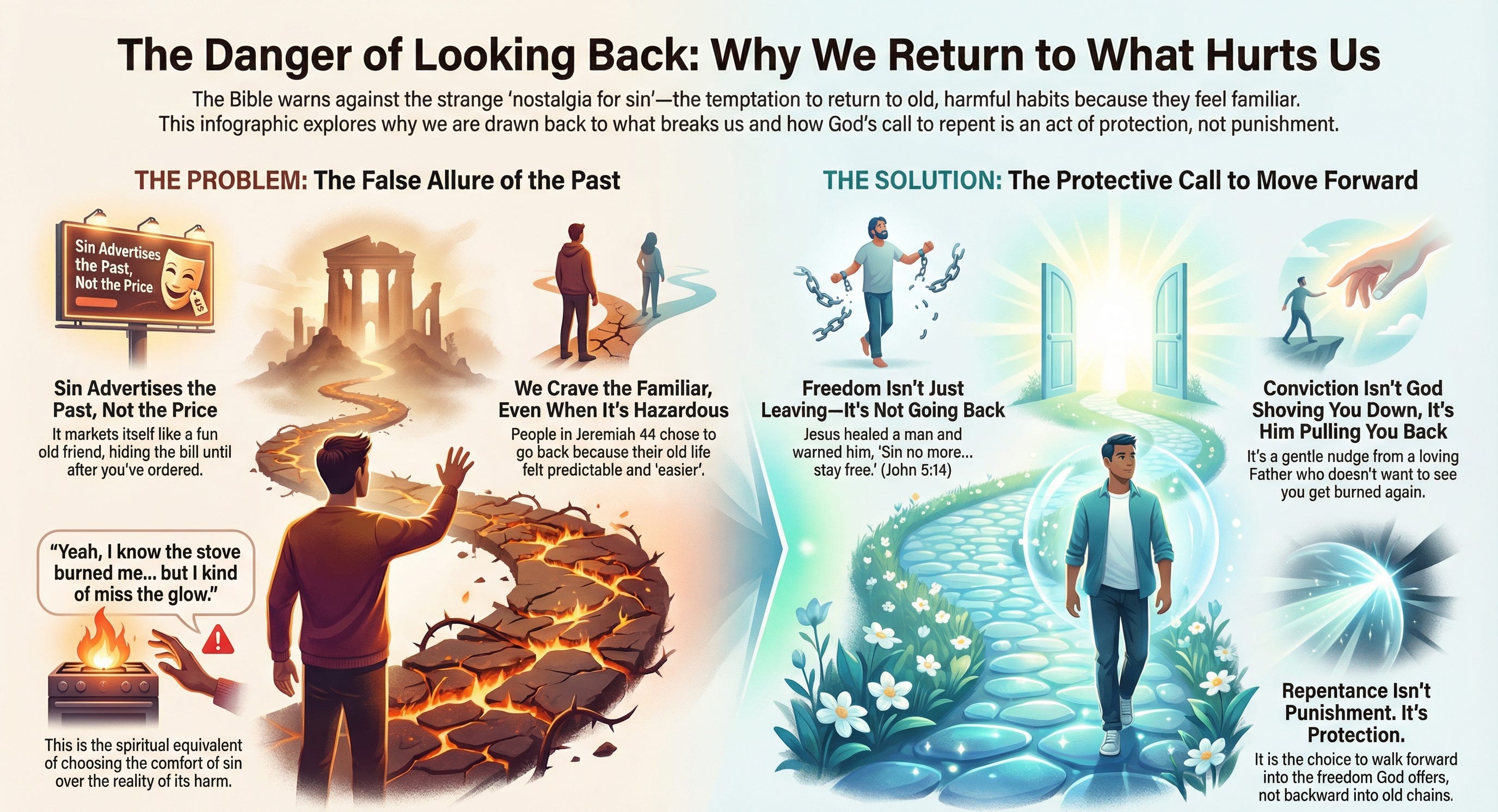
The people of Judah weren’t confused. Not at all.
They had:
Seen God move
Heard Him warn
Watched Him rescue
Benefited from His patience
They were living, breathing proof that God intervenes.
And yet… they made a decision that honestly feels wild when you read it:
They told Jeremiah, “We’ve heard what God said… but we’re going back to what we used to do. Life felt easier then.”
It’s almost breathtaking in its honesty.
It’s the spiritual equivalent of saying,
“Yeah, I know the stove burned me… but I kind of miss the glow.”
This is the root of many modern struggles — returning to old sins, fallen comforts, toxic environments, or idols of convenience. This is why so many Christians battle:
temptation
addiction cycles
old relationships that pull them down
hidden habits
spiritual complacency
Jeremiah 44 refuses to let us dodge the question:
“Are you returning to something God already freed you from?”
Sin Always Advertises the Past — Never the Price
The people went back because it felt familiar. Predictable.
That’s the thing about sin: it dresses up like home even when it’s hazardous.
Old habits say,
“Hey… remember how good it felt?”
The people ran back because sin looked familiar.
Predictable. Safe.
Old sin always markets itself like a former friend you “used to have fun with.”
But behind the curtain?
Bondage.
Oppression.
Loss of peace.
Sin doesn’t show the bill until after you’ve ordered.
And here’s the thing:
God wasn’t angry and shouting in Jeremiah 44.
He was grieving. Warning. Protecting.
Like a Father saying:
“You don’t have to go back. You don’t have to break again.”
John 5:14 — Jesus Says the Same Thing
When Jesus healed the crippled man at Bethesda, He didn’t just restore his legs.
He restored his future.
But then He said something we don’t always like to talk about:
“See, you are well! Sin no more, that nothing worse may happen to you.”
That wasn’t Jesus threatening him — it was Jesus protecting him.
In other words:
“Don’t return to the thing that broke you. You’re free now. Stay free.”
And that’s the thread binding John 5 and Jeremiah 44 together:
God rescues us and calls us to walk differently because
freedom isn’t just about leaving something — it’s about not going back.
When Conviction Hits Home
Conviction never shows up to ruin your day.
It shows up to save it.
It’s not God shoving you down.
It’s Him pulling you back.
A gentle tug on the heart.
A quiet nudge in the spirit.
A moment where something inside you whispers:
“You’re not that person anymore.”
Tozer once said:
“What comes into our minds when we think about God is the most important thing about us.”
The people in Jeremiah’s day didn’t trust God.
He felt inconvenient. Restrictive.
So they ran to the idols that made fewer demands.
But Spurgeon reminds us:
“God is too good to be unkind and too wise to be mistaken.”
If they had believed that… they wouldn’t have gone back.
So What’s the Holy Spirit Saying This Month?
Same message as Jeremiah 44.
Same message as John 5:14.
Repent.
Come home.
Don’t return to what hurt you.
Walk forward, not backward.
God isn’t mad…
He just loves you too much to let you keep touching the stove.
He healed you and set you free.
And He’s still whispering:
“Stay with Me.
Let go of the old fire.
Choose life, not nostalgia.”
Repentance isn’t punishment.
It’s protection.
And honestly?
The freedom on the other side is worth it.
Briefing on the Spiritual Concept of “Return”
Executive Summary
This document synthesizes a theological analysis of the word “return,” focusing on its spiritually perilous implications. The central argument posits that while “return” can be a benign concept, it often signifies a dangerous regression to past sins and destructive habits. Drawing primarily from the biblical accounts in Jeremiah 44 and John 5:14, the analysis reveals that sin creates a false nostalgia, marketing itself as familiar and safe while hiding its true cost of bondage and oppression.
The core takeaway is that God’s warnings against returning to past transgressions are not rooted in anger but in a protective, fatherly love. Conviction is framed as a divine intervention meant to save, not condemn, reminding individuals of their transformed identity. Ultimately, true spiritual freedom is defined not merely as escaping bondage but as the ongoing choice not to go back. The document concludes that repentance is a protective act, and the call to move forward—away from the “nostalgia for sin”—is a call to embrace a more valuable and lasting freedom.
--------------------------------------------------------------------------------
1. The Duality of “Return”
The concept of “return” possesses a dual meaning. In common parlance, it evokes harmless or positive imagery, such as returning home or returning to normalcy. However, in a spiritual context, “return” carries a heavier weight, signifying a drift back toward “old chains” that were supposedly broken. This analysis centers on the act of returning to past sins, fallen comforts, toxic environments, and idols of convenience.
2. Historical Precedent: The Case of Jeremiah 44
The 44th chapter of Jeremiah provides a stark illustration of the “strange nostalgia for sin.” The people of Judah, despite having direct and profound experience with God’s power, made a conscious decision to revert to their former ways of life.
Evidence of Divine Intervention Ignored:
They had witnessed God’s actions (”Seen God move”).
They had received direct prophetic warnings (”Heard Him warn”).
They had been beneficiaries of His deliverance (”Watched Him rescue”).
They had experienced His forbearance (”Benefited from His patience”).
Despite this, they explicitly rejected the divine message, stating a preference for their old practices because “Life felt easier then.” This decision is characterized as being breathtaking in its honesty, analogous to saying, “Yeah, I know the stove burned me… but I kind of miss the glow.” This historical account is presented as the root of many modern Christian struggles, including:
Temptation and addiction cycles
Regressive relationships
Hidden, destructive habits
Spiritual complacency
The central question posed by this biblical passage is: “Are you returning to something God already freed you from?”
3. The Deceptive Marketing of Sin
The analysis argues that sin’s appeal lies in its familiarity and predictability. It actively markets itself as a comfortable and safe alternative, masking its inherent danger.
Sin’s Advertisement Strategy: It appeals to nostalgia, with old habits prompting, “Hey… remember how good it felt?” It presents itself as a former, fun-loving friend.
The Hidden Cost: Behind this facade of familiarity lies the reality of bondage, oppression, and the loss of peace.
Delayed Consequences: A key characteristic of sin is that it “doesn’t show the bill until after you’ve ordered.”
4. The Character of God: Protection Over Punishment
Contrary to a punitive interpretation, God’s response in Jeremiah 44 is framed as one of grief, warning, and protection. His motivation is likened to that of a loving father seeking to prevent his child from harm. The divine message is interpreted as a plea: “You don’t have to go back. You don’t have to break again.”
This perspective is reinforced by the final analogy: “God isn’t mad…He just loves you too much to let you keep touching the stove.”
5. New Testament Parallel: John 5:14
The theme of not returning to a destructive past is directly connected to the New Testament through the account of Jesus healing the crippled man at Bethesda. After restoring the man’s physical health, Jesus gives him a crucial instruction:
“See, you are well! Sin no more, that nothing worse may happen to you.”
This statement is interpreted not as a threat but as an act of protection. Jesus restored the man’s future and was instructing him on how to preserve it. The message is paraphrased as: “Don’t return to the thing that broke you. You’re free now. Stay free.”
The accounts in Jeremiah 44 and John 5 are bound by a shared principle: Freedom isn’t just about leaving something — it’s about not going back.
6. The Nature and Function of Conviction
Spiritual conviction is presented as a fundamentally positive and protective force, distinct from condemnation.
Purpose: Conviction “shows up to save your day,” not to ruin it.
Mechanism: It is described as God “pulling you back,” a “gentle tug on the heart,” or a “quiet nudge in the spirit.”
Message: At its core, conviction is an internal whisper affirming a changed identity: “You’re not that person anymore.”
7. Theological Perception and Its Behavioral Impact
The decision to return to sin is linked directly to an individual’s perception of God. The analysis leverages quotes from prominent theologians to support this point.
Theologian
Quotation
Implication
A.W. Tozer
“What comes into our minds when we think about God is the most important thing about us.”
A person’s core theology dictates their actions.
Charles Spurgeon
“God is too good to be unkind and too wise to be mistaken.”
Trust in God’s essential goodness and wisdom would prevent a return to sin.
The people in Jeremiah’s time returned to idols because they viewed God as “inconvenient” and “restrictive,” while idols made fewer demands. Had they embraced a view of God as fundamentally good and wise, the text argues, they would not have gone back.
8. The Concluding Mandate: Repentance as Protection
The consistent message across both the Old and New Testament examples is a clear call to action:
Repent.
Come home.
Don’t return to what hurts you.
Walk forward, not backward.
This call is rooted in God’s love and desire for protection. The conclusion frames repentance not as a form of punishment, but as a necessary safeguard for the freedom that has been granted. The final assertion is that this freedom is worth “letting go of the old fire” of nostalgic sin.
Study Guide: The Nostalgia for Sin and the Call to Return
Quiz
Answer the following questions in 2-3 complete sentences, based on the provided source context.
What is the central spiritual problem associated with the word “Return” as described in the text?
In Jeremiah 44, why did the people of Judah decide to go back to their old ways despite knowing God’s power?
According to the analysis, how does sin market itself to people who have been freed from it?
Explain the analogy of sin not showing “the bill until after you’ve ordered.”
What was Jesus’s primary message to the healed man in John 5:14, and how is it interpreted as an act of protection?
What is the common thread that binds the messages of Jeremiah 44 and John 5:14 together?
How does the text describe God’s emotional response in Jeremiah 44?
According to the source, what is the true purpose of spiritual conviction?
Based on the A.W. Tozer quote, why did the people in Jeremiah’s day run to idols?
How is repentance redefined at the end of the text? Is it a punishment or something else?
--------------------------------------------------------------------------------
Answer Key
The central spiritual problem with “Return” is not about going back to harmless things, but about drifting back to old sins and chains that one was previously freed from. It is the act of choosing to go back to something destructive, such as fallen comforts, toxic environments, or idols.
The people of Judah chose to return to their old ways because life felt easier and more familiar then. Despite having seen God rescue and provide for them, they were drawn to the predictability of their past sins, viewing them as a form of comfort.
Sin markets itself by appearing familiar, predictable, and safe, like a former friend one “used to have fun with.” It advertises the memory of past feelings and dresses up like home, even when it is a hazardous environment.
This analogy means that sin only presents its appealing, familiar side upfront, hiding the true consequences. The negative outcomes—such as bondage, oppression, and loss of peace—are only revealed after a person has already committed to returning to the old habit.
In John 5:14, Jesus told the healed man, “Sin no more, that nothing worse may happen to you.” This is interpreted not as a threat, but as an act of protection, essentially telling the man to stay free and not return to the very thing that broke him in the first place.
The common thread is that God rescues people and calls them to walk differently afterward. True freedom is not just about the initial act of leaving a destructive situation, but about the ongoing commitment not to go back to it.
God’s response in Jeremiah 44 is portrayed not as simple anger, but as grief and a desire to protect His people. He is depicted as a loving Father warning his children, saying, “You don’t have to go back. You don’t have to break again.”
The true purpose of conviction is to save a person’s day, not ruin it. It is described as God pulling someone back from harm rather than shoving them down, manifesting as a gentle tug on the heart or a quiet nudge in the spirit.
A.W. Tozer is quoted as saying, “What comes into our minds when we think about God is the most important thing about us.” The people in Jeremiah’s day did not trust God, viewing Him as inconvenient and restrictive, so they ran to idols that made fewer demands on them.
Repentance is redefined not as punishment, but as protection. It is the act of choosing life over nostalgia for sin and walking forward instead of backward, which ultimately leads to a freedom that is “worth it.”
--------------------------------------------------------------------------------
Essay Questions
Analyze the concept of “nostalgia for sin” using the primary biblical example of Jeremiah 44 and the modern struggles listed in the text (addiction, toxic relationships, spiritual complacency).
Discuss the portrayal of God’s character in the text. How do the interpretations of Jeremiah 44 and John 5:14 work together to present a view of God as a protective, grieving Father rather than a punitive figure?
Explore the “marketing” of sin as described in the source. Using the analogies of sin as a “former friend” and a comforting but “hazardous” home, explain the psychological and spiritual appeal of returning to old, destructive habits.
Explain the relationship between conviction, repentance, and freedom as outlined in the text. How does the source frame these concepts as a unified, protective process initiated by God?
Using the provided quotes from A.W. Tozer and Charles Spurgeon, argue how a person’s fundamental belief about God’s nature directly influences their decision to either “return” to sin or “walk forward” in freedom.
--------------------------------------------------------------------------------
Glossary of Key Terms
Term
Definition from Source Context
Return
The spiritual act of drifting back to old chains, fallen comforts, toxic environments, or idols of convenience that God has already provided freedom from.
Nostalgia for Sin
The spiritual equivalent of knowing something is harmful (like a hot stove) but missing its perceived comfort or familiarity (”the glow”).
Idols of Convenience
False gods or comforts that people run to because they make fewer demands than the true God, who may feel inconvenient or restrictive.
Bondage
The hidden price and consequence of sin, such as oppression and loss of peace, which is concealed behind sin’s familiar and predictable appearance.
Conviction
A protective act from God intended to save, not ruin. It is described as a “gentle tug on the heart” or a “quiet nudge in the spirit” that pulls a person back from sin.
Freedom
A state that is not only about the initial act of leaving something destructive but, more importantly, about the ongoing commitment to not go back.
Repentance
A form of protection, not punishment. It is the act of choosing to walk forward with God, letting go of old fires, and choosing life instead of nostalgia for sin.
This is too good! Thank you for this!
Thank you for the kind comment! The encouragement alone means a lot! God Bless You!