

What Biblical Mercy Really Means—and Why It’s More Active Than We Think
Our Weekly Heat Map | Greek/Lexical Translation Series

(Paid Subscribers - Scroll to bottom for your visual Heat Map)
Each week, we create visual Greek & lexical Heat Maps—simple, tangible guides that show how a word is used, where it appears, and why it matters in real life. Just clarity you can see. If you enjoy slowing down and actually understanding what the Bible is saying beneath the English, you’re invited to go deeper with us. Subscribing helps support this work—and gives you full access to each week’s study.
Why This Matters for You
By looking at the original Greek definitions, the Bible stops feeling like a list of “sermons and slogans” and starts feeling alive.
• Clarity: You see exactly what God is doing, not just how He feels.
• Connection: You see how these words play out in ordinary life, making the text more personal.
• Depth: You find a “clearer view” of what is happening beneath the English translation.
Greek Word of the Week: Mercy (ἔλεος / eleos)
We love mercy.
Mostly when it’s pointed in our direction.
In Greek, mercy isn’t God waving things off with a tired sigh.
The word—eleos—has motion. It steps in, gets involved, and costs something.
What I learned this week:
In Scripture, mercy isn’t rooted in emotion.
It’s rooted in covenant loyalty.
God doesn’t extend mercy because we finally figured things out.
He does it because He promised Himself He would.
Which quietly raises a question worth sitting with:
If mercy moves toward the broken,
what does it look like when it shows up in ordinary lives—ours included?
That question is where this word really opens up.
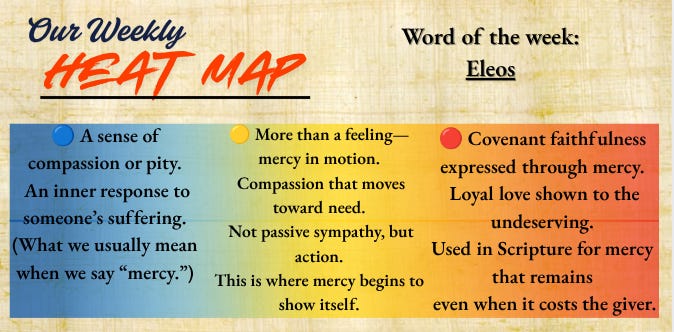
Check out this preview of last week’s Heat Map 👇 👇 👇 👇
One detail that stood out in the Greek this week:
Eleos (mercy) is often paired with action verbs in the New Testament. It’s not passive. It’s something that happens—someone moves, intervenes, and restores.
Even more interesting, the word shows up repeatedly in contexts involving covenant faithfulness, not emotional response. Mercy flows from commitment, not mood. That means biblical mercy isn’t God reacting to us in the moment—it’s God acting according to who He is.
When Jesus speaks about mercy, He treats it less like a virtue to admire and more like a way of life that reveals what’s really happening in the heart.
That’s where this word starts to feel very close to home.
In this study, I walk through how eleos is used in the New Testament, how Jesus applies it in ways we often skim past, and why mercy isn’t as abstract—or as distant—as we like to think.
If you’ve ever wondered what mercy actually looks like on the ground, not just in theory, you may enjoy going deeper with me in this week’s Heat Map.
Preview of today’s Heat Map:
Thank you for your support
—Thomas M. Hamlyn
Keep reading with a 7-day free trial
Subscribe to Narrow Path Collective to keep reading this post and get 7 days of free access to the full post archives.